
Applied to 50+ Jobs? Improve Your Interview Rate in 2026
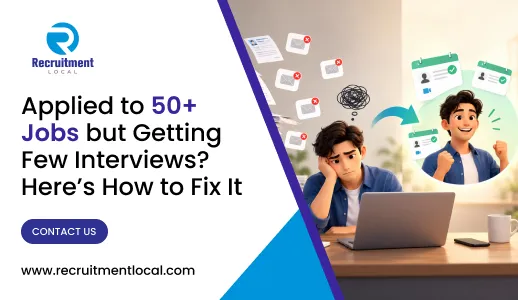
Applied to 50+ Jobs but Getting Only 2–3 Interviews? Here’s What to Do
You update your resume, search job boards, submit applications, and wait. A few days pass, then a few weeks. Despite applying to dozens of positions, your inbox remains quiet. Perhaps you receive a couple of interview invitations, but most applications lead nowhere.
If you have applied to 50 or more jobs and received only two or three interviews, it does not automatically mean you lack the skills employers want. Your job search strategy may need improvement.
In today's competitive hiring environment, sending more applications is not always the answer. The goal is to make each application relevant, demonstrate your value quickly, and reach employers whose requirements match your experience.
Here are seven practical ways to identify what is holding back your job search.
1. Stop Applying to Every Job That Looks Interesting
One common mistake is applying to roles simply because the job title sounds suitable. Two positions with the same title can have very different responsibilities, experience requirements, and technical expectations.
For example, a digital marketing specialist role might require technical SEO, analytics, and website auditing, while another may focus on paid advertising and campaign management.
Before applying, check:
Whether you meet the essential qualifications.
Whether your experience matches the primary responsibilities.
Whether you have examples of the results the employer wants.
Whether the role fits your location, salary expectations, and career direction.
Create a shortlist of roles that genuinely match your skills. A focused job search strategy can help you spend less time on unsuitable applications and more time preparing strong ones.
2. Check Whether Your Resume Matches the Job Description
Your resume may describe your experience accurately but still fail to communicate why you are a strong candidate for a particular position.
Employers often scan resumes. Recruitment systems may also parse resume information before a recruiter reviews it. An ATS-friendly resume should therefore use clear formatting, conventional headings, and relevant language from the job description where it truthfully reflects your experience.
Review your resume for:
Relevant skills and qualifications near the top.
Clear descriptions of your responsibilities and achievements.
Measurable outcomes where you have reliable figures.
Keywords that genuinely match your work.
Readable formatting without unnecessary graphics or complex layouts.
Avoid copying an entire job description into your resume. Keyword relevance matters, but accuracy and credibility matter too.
If you are applying for different types of roles, consider creating tailored resume versions instead of using one generic document for every application. Professional resume writing or ATS resume optimization services can help you identify gaps and communicate your experience more clearly.
3. Turn Responsibilities Into Achievements
A resume filled with duties can make it difficult for employers to understand your impact.
Compare these examples:
Duty-focused: Responsible for managing social media accounts.
Impact-focused: Managed social media content calendars, monitored engagement, and coordinated campaigns to support brand visibility.
The second version explains the work in more detail without inventing results. If you have verified performance figures, you can make it stronger by including them.
Use this simple structure:
Action + task or challenge + result.
You do not need a number in every bullet. Focus on showing the scope of your work, the skills you used, and the value you contributed.
4. Make Your LinkedIn Profile Support Your Resume
Recruiters may look at your LinkedIn profile after reviewing your application. If the profile is incomplete, outdated, or inconsistent with your resume, you could miss an opportunity to strengthen your candidacy.
Start with these improvements:
Use a headline that identifies your professional focus and relevant strengths.
Write an About section that explains your experience, skills, and career direction.
Add meaningful detail to your recent positions.
Highlight relevant projects, certifications, and skills.
Keep employment dates and role descriptions consistent with your resume.
LinkedIn profile optimization is not about filling every section with keywords. It is about making your professional background easier to understand and discover.
Your profile should answer three questions: What do you do? What are you good at? What kind of opportunity are you pursuing?
5. Improve the Quality of Your Applications
Before submitting an application, spend a few minutes comparing your resume with the job requirements.
Identify the three to five most important qualifications in the listing. Check whether your resume demonstrates those qualifications clearly. Adjust the summary, skills, or relevant experience where appropriate, without exaggerating your background.
Keep a simple application tracker with the following details:
Field | What to record |
Company and role | The position you applied for |
Application date | When you submitted it |
Resume version | Which tailored resume you used |
Follow-up | Any permitted follow-up date |
Outcome | Rejection, response, interview, or pending |
After several weeks, review the pattern. If you receive few responses, your targeting, resume, or application approach may need attention. If you receive interviews but struggle to progress, interview preparation may be the bigger issue.
6. Build a Job Search Beyond Job Boards
Job boards are useful, but they are not the only way to discover opportunities.
You can also:
Follow target employers and their career pages.
Connect with relevant professionals and recruiters.
Ask former colleagues about suitable openings.
Participate in professional communities.
Contact people with thoughtful, personalized messages.
Track companies that regularly recruit for your target role.
Networking does not mean asking strangers to give you a job. It means building professional relationships, learning about opportunities, and communicating your interests clearly.
Keep outreach respectful and concise. Do not send identical messages to dozens of people or repeatedly contact someone who has not responded.
7. Know When to Get Professional Job Search Assistance
If you have tried different resume versions, improved your LinkedIn profile, and refined your applications but still struggle to gain traction, an outside review may help identify blind spots.
Depending on your needs, professional support could include resume writing, LinkedIn profile optimization, interview coaching, or structured job search assistance.
A dedicated career manager can help organize your search, identify relevant opportunities, coordinate application activity, and provide ongoing guidance. Before choosing a service, ask what is included, how progress is reported, and what outcomes are realistic. No service can guarantee that an employer will hire you.
A Practical 7-Day Reset Plan
Day 1: Choose one target role and review ten relevant job descriptions.
Day 2: Update your resume to reflect the essential requirements you genuinely meet.
Day 3: Improve your LinkedIn headline, About section, and recent experience.
Day 4: Identify five suitable roles and tailor your applications.
Day 5: Contact two or three relevant professional connections with personalized messages.
Day 6: Practice answers to common interview questions and prepare examples of your achievements.
Day 7: Review your tracker, identify gaps, and plan the next week.
Final Thoughts
Applying to 50 jobs and receiving only two or three interviews can be frustrating, but application volume alone does not measure your potential. The more useful question is where your job search is losing momentum.
Start by improving role selection, resume relevance, LinkedIn visibility, and application quality. If interviews are the main obstacle, invest time in structured practice. If you need a more organized process, consider professional career support.
RecruitmentLocal offers career services such as resume writing, LinkedIn optimization, interview preparation, and dedicated career management to help job seekers build a more structured search. Explore the service that fits your needs and make your next applications more intentional.