
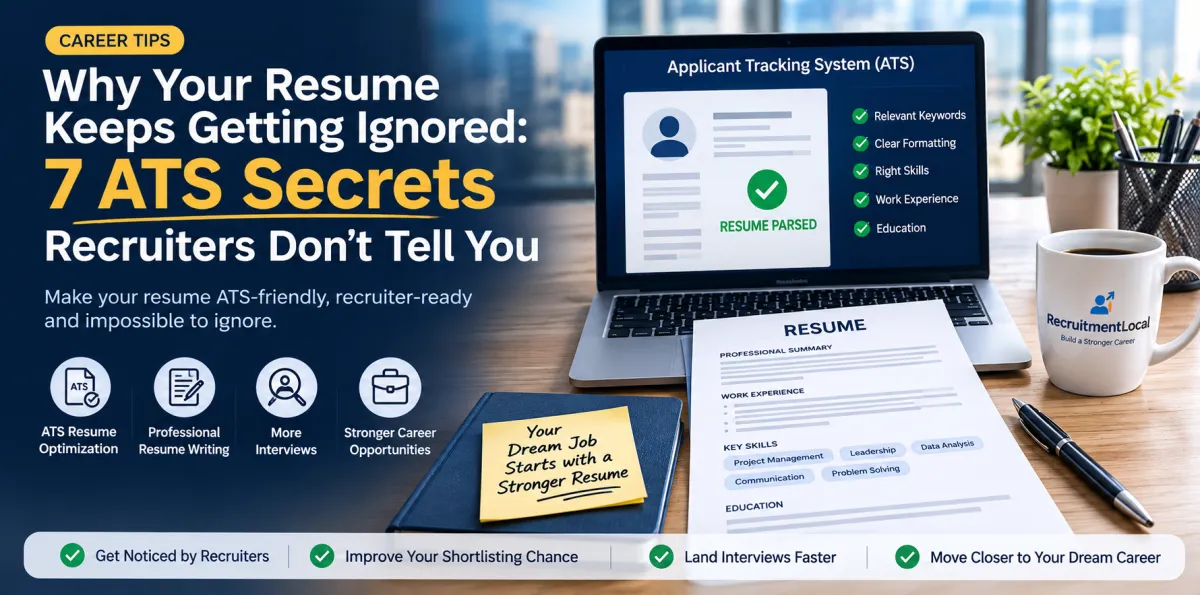
Why Your Resume Keeps Getting Ignored: 7 ATS Secrets Recruiters Don't Tell You
You have the right experience. You have the skills. You have applied to jobs that seem like a strong match. Yet your inbox stays quiet.
If this sounds familiar, your resume may not be communicating your qualifications as effectively as it could.
Many companies use Applicant Tracking Systems (ATS) to collect, organize, search, and manage job applications. These systems can parse information from resumes and turn it into structured candidate data that recruiters can review and search. For example, Workday explains that its resume parsing technology extracts information such as education, skills, and work history, while Greenhouse also uses resume parsing to populate candidate profiles.
That does not mean an ATS is a magical robot that simply rejects every resume missing a keyword. The reality is more nuanced. Your resume needs to be easy for recruiting technology to interpret and, just as importantly, compelling enough for a recruiter to understand your value.
Here are seven practical ATS resume optimization principles that can improve the quality of your applications.
1. Your Resume Must Match the Job You Actually Want
One of the biggest resume mistakes is using the same document for every application.
A strong resume should reflect the position you are targeting.
Start by reviewing the job description and identifying the employer's most important requirements. Look for:
Required technical skills
Job-specific terminology
Certifications
Relevant tools and software
Leadership responsibilities
Industry experience
Required years of experience
Core responsibilities
For example, if a position repeatedly mentions project management, stakeholder communication, budgeting, and cross-functional leadership, your resume should clearly demonstrate relevant experience in those areas—provided you genuinely have it.
This is where professional resume help can make a difference. The goal isn't to stuff your resume with keywords. It is to connect your experience with the employer's requirements.
2. Don't Treat Keywords Like a Secret Code
You may have heard that ATS systems simply count keywords.
That's an oversimplification.
Modern recruiting systems can use parsing, structured application information, search functionality, and other methods to help recruiters organize and evaluate candidates. Workday notes that some systems can interpret related language rather than simply counting exact keyword matches.
The better strategy is to use relevant terminology naturally.
For example, if the job description asks for "customer relationship management," and you genuinely have that experience, don't hide it behind vague language such as "managed client interactions."
Instead, clearly describe the experience:
Weak:
"Worked with customers and maintained relationships."
Stronger:
"Managed customer relationships using CRM platforms, improving retention and follow-up processes."
The second version communicates the responsibility, relevant terminology, and business context more clearly.
3. Fancy Formatting Can Work Against You
A visually impressive resume isn't automatically an effective resume.
Complex tables, graphics, text boxes, unusual layouts, images, and multiple columns can create problems for resume parsing systems.
Greenhouse specifically identifies formatting issues such as graphics, images, tables, headers, footers, text boxes, and column-based layouts as potential causes of unsuccessful or incomplete resume parsing.
That doesn't mean every ATS-compatible resume must look boring.
It means clarity should come before decoration.
Use recognizable section headings such as:
Professional Summary
Work Experience
Education
Skills
Certifications
Keep important information in the main body of the document rather than hiding critical details inside graphics or design elements.
4. Your Job Titles Need to Be Understandable
Recruiters and recruiting systems need to understand what you actually did.
Creative internal job titles can sometimes create confusion.
Never invent a title or change your employment history to match a job description. Instead, make legitimate responsibilities and expertise easier to understand.
Your resume should accurately represent your career while making your relevant qualifications obvious.
5. Your Experience Section Should Show Results, Not Just Responsibilities
A resume that only lists duties can make a qualified professional look average.
Compare:
Responsible for managing sales accounts.
with:
Managed a portfolio of 45 B2B accounts, increasing quarterly revenue by 18% through targeted upselling and account retention strategies.
The second statement gives the reader evidence.
Whenever possible, show:
Revenue generated
Cost savings
Percentage improvements
Team size
Customer volume
Projects completed
Time saved
Efficiency improvements
Sales growth
Operational results
Numbers aren't mandatory for every bullet, but measurable outcomes can make your experience much easier to evaluate.
6. Don't Hide Your Most Relevant Skills
Your resume should make important qualifications easy to find.
If a job requires Salesforce, SQL, financial analysis, project management, or another specific skill that you genuinely possess, don't bury it somewhere in an unrelated paragraph.
Create a clear skills section and reinforce important skills through your experience where appropriate.
For example:
Skills:
Salesforce, Account Management, Business Development, CRM Strategy, Pipeline Management
Then demonstrate those skills in your experience section.
This creates a more consistent professional story.
A good ATS resume optimization process therefore isn't about adding hundreds of keywords. It is about creating alignment between your skills, experience, career goals, and the role you're pursuing.
7. Your Resume Still Has to Impress a Human
This is the most important "secret."
ATS optimization is not the final goal.
Getting your information parsed correctly is only part of the application process. Your resume ultimately needs to help a recruiter or hiring manager understand why you are relevant to the position.
A recruiter should be able to quickly answer:
What does this person do?
What level are they at?
What industries or functions do they understand?
What results have they produced?
Why are they relevant to this particular position?
If those answers aren't obvious, adding more keywords won't solve the underlying problem.
A Better ATS Resume Checklist
Before submitting your next application, ask yourself:
Is my target position obvious?
Does my professional summary match my career direction?
Have I included relevant skills I genuinely possess?
Does my experience demonstrate results?
Are important job requirements reflected in my experience?
Are my section headings clear?
Is my resume easy to read?
Does the document avoid unnecessary graphics and complex formatting?
Are my dates, job titles, employers, and education clearly presented?
Have I reviewed the resume against the specific job description?
If several answers are "no," your resume probably needs more than a cosmetic update.
When Should You Consider Professional Resume Help?
You don't necessarily need a professional resume writer every time you change jobs.
However, professional support can be particularly useful when:
You're changing careers.
You're applying for management or executive positions.
You're getting applications but few interviews.
Your resume hasn't been updated for several years.
You have strong experience but struggle to communicate it.
Your resume is overly long or unfocused.
You're unsure how to position transferable skills.
You're returning to work after a career break.
You're applying to highly competitive positions.
You're sending many applications without meaningful results.
A professional resume review service can help identify weaknesses that are easy to overlook when you've been editing your own resume for years.
At RecruitmentLocal, resume support is part of a broader career-management approach. The company's services include ATS-focused resume optimization, LinkedIn profile optimization, interview preparation, salary negotiation support, and dedicated career-management assistance.
The Goal Isn't to "Beat" the ATS
The best approach isn't to trick an Applicant Tracking System.
It's to create an accurate, readable, relevant resume that works for both technology and people.
Think of your resume as a bridge.
On one side is the job description and the employer's requirements. On the other side is your actual experience, skills, and achievements.
Effective ATS resume optimization helps connect the two.
If you've been applying repeatedly without getting the response you expected, don't automatically assume you're unqualified. Review how clearly your resume communicates your value, how closely it aligns with the roles you're targeting, and whether its formatting allows your information to be interpreted correctly.
Sometimes the problem isn't your career.
It is the way your career is being presented.
Ready for a stronger application strategy? RecruitmentLocal provides professional resume writing and optimization support designed to help job seekers present their experience clearly, improve their professional positioning, and approach their job search with greater confidence.
